























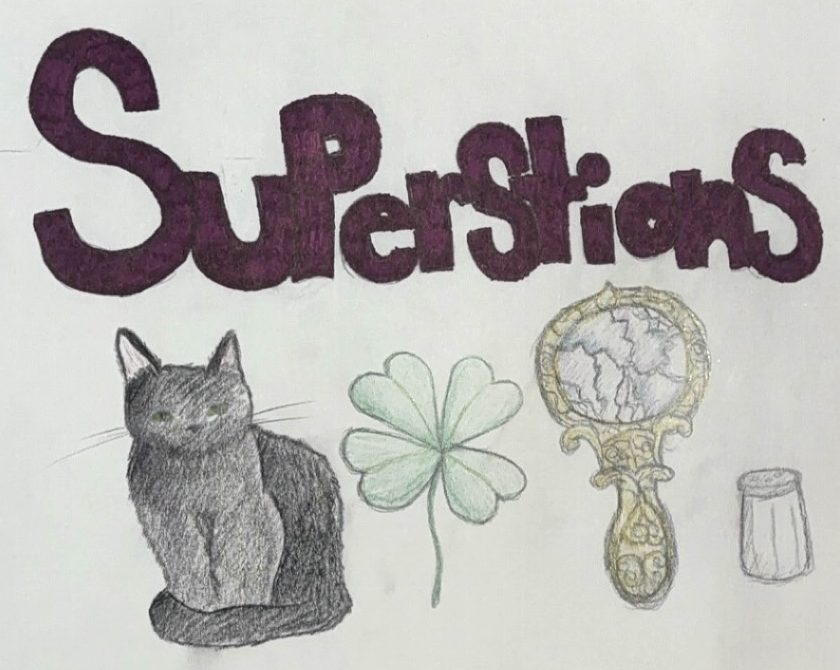
Do you believe in superstitions? Superstitions aren’t as common as they once were years ago, but many people still believe they impact our everyday life.
Superstitions are cultural myths or beliefs that could potentially lead to misfortune or the complete opposite depending on the circumstance. Superstitions originated in ancient Greece, 4th century BCE; mainly being created due to religious beliefs.
There’s a long list of superstitions that have been created throughout the years, such as a four-leaf clover bringing good luck or walking underneath a ladder bringing you misfortune. Whether you believe in superstitions or not, they are an essential part of history that is worth learning about.
The Black Cat
As you’re walking across the street, a black cat crosses your path; you might’ve heard someone say that you should change your path or you will be granted with bad luck, but are black cats truly all that bad?
According to the poll I sent out, it is unanimous, but not surprising; 0% of students believe that these furry feline creatures bring you bad luck.
This superstition originates from medieval times when people believed that animals with dark feathers or fur symbolized death or bad luck, which eventually grew into the myth of black cats bringing you misfortune. Unfortunately, black cats are affected by this greatly. In animal shelters, black cats tend to be less likely to be adopted than cats with a different fur coat, due to this belief. Not only are black cats unwanted by a lot of people, but they are often found diseased or abused only because of the color of their fur. If you own a black cat, make sure to give them lots of love; they may need it.
Four-leaf Clover
We’ve all heard as a kid that if you find a four-leaf clover somewhere in the grass, you will be granted with good luck, but how true is this theory?
This superstition is quite popular amongst Harrison wildcats with 57.1% of students claiming they believe in the luck of a four-leaf clover.
Finding a four-leaf clover is extremely rare with only one in 5,000 having four leaves; could this be why they symbolize good luck? This green good-luck charm dates back to many centuries ago, originating in Ireland, but also is believed in many other cultures. People often carry the four-leaf clover around with them if they happen to find one as they are said to represent faith, hope, love, and luck!
Crossed Fingers
Have you ever been in a situation where you really wanted something to happen? Try crossing your fingers, you’ll be sure to gain some luck!
Crossing your fingers seemed to be the most popular belief amongst Harrison wildcats with 71.4% of students believing in this method; the results were not surprising given that it is very well known and taught by your parents or peers from a young age.
Crossed fingers is a hand gesture often used when you are wishing for luck or hope. Crossing your fingers symbolizes the cross dating back to a pre-Christianity belief in Western Europe when religion was banned. It was originally created to force followers into developing secret signs as a way to communicate with each other. Eventually, crossing your fingers evolved into something different as it now means to wish or hope for something.
Breaking a Mirror
Have you ever broken a mirror before and thought “Am I going to be granted 7 years of bad luck?”
Breaking a mirror is a well-known superstition that is said to give you bad luck if not prevented. According to the poll results, 28.6% of Harrison wildcats who answered believe breaking a mirror grants you bad luck. This superstition originated in ancient Greece and the Roman Empire where reflected images were thought to have some sort of powers. Breaking a mirror was also considered highly disrespectful and not tolerated, which could also be a reason as to why this superstition rose in popularity.
Knocking on Wood
You may have heard that knocking on wood wards off bad luck after you have tempted your fate; why might people say this?
According to the poll that was sent out to Harrison wildcats, 42.9% of students believe in knocking on wood.
People often say the phrase “knock on wood” just out of habit to reverse a jinx, but knocking on wood used to mean so much more. One theory of this superstition traces back to ancient Pagan cultures. The reason we knock on wood instead of metal or plastic is because the Celts believed that spirits and gods were in the trees. To them, knocking on tree trunks served them protection. This is just one theory, however, there are many more. The origin of knocking on wood will never be known for certain, but it still stands and continues to grow more every day.