

















Alexander Hamilton never should have had a shot to begin with. Unlike how he is portrayed in the musical, Alexander Hamilton was far from an American hero. He may be the “ten dollar Founding Father without a father,” and may have “got a lot farther by working a lot harder,” but this does not mean he should be glorified with a musical.
We’ve seen before with movies and shows like The Greatest Showman that glorify a horrible, horrible person. For those unaware, The Greatest Showman tells the story of P.T. Barnum, an American businessman who built his fortune through exploitation of others, particularly people with disabilities, and animal cruelty. However, just by watching the movie, you’d have no idea.
Glorification of historical figures is a serious problem. Newspaper SanBenito found that glorifying historical figures can cause distorted or “whitewashed” views of historical events. It can also cause their misdeeds and wrongdoings to be completely ignored or even justified in some way.
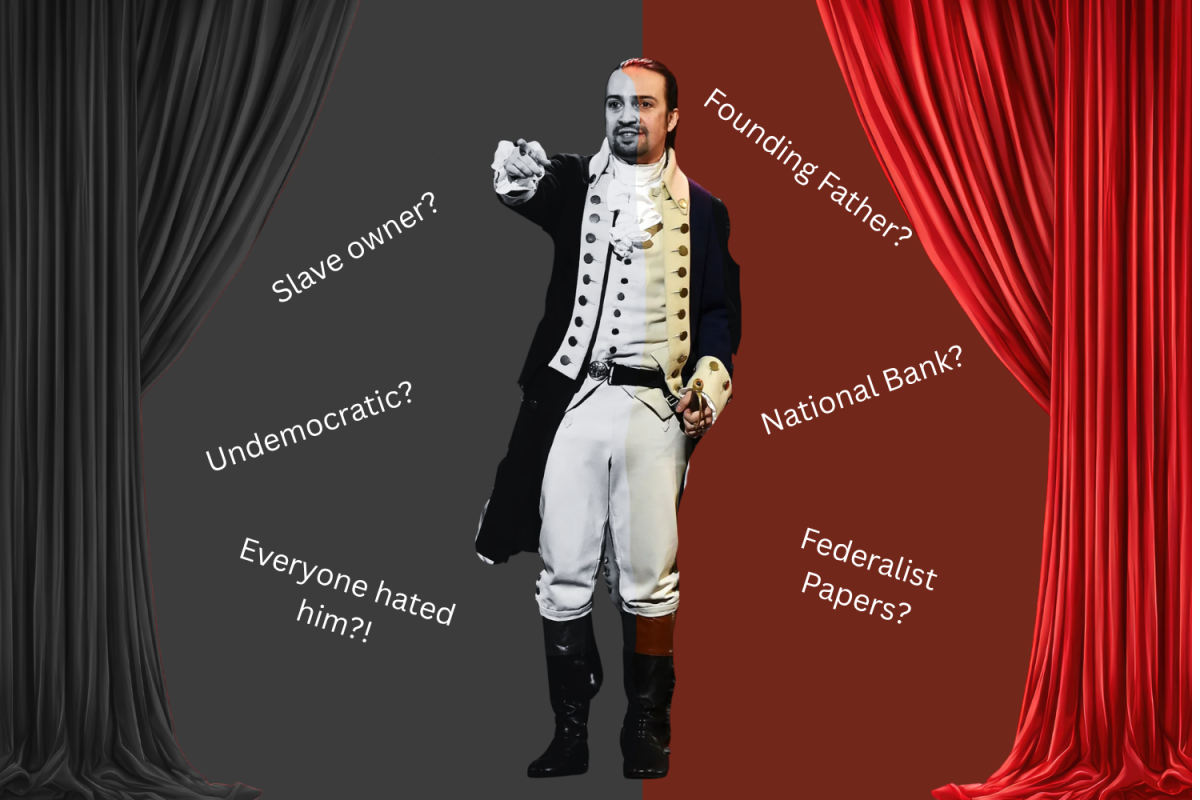
But what did Hamilton actually do to earn my hatred? To begin, Hamilton, as indicated by recent research, owned slaves in his personal household. This is noted by both the historian’s website History and the National African American Reparations Commission. This contradicts the idea that Hamilton was a profound abolitionist. While yes, he did believe slavery was immoral, he used slavery to advance his fortune and for personal gain. This detracts from his legacy and, as History notes, takes him out of the category of great abolitionists such as John Adams, Samuel Adams, Gouverneur Morris, and Thomas Paine. Instead, it puts him in a category along with Washington, Thomas Jefferson, and John Jay where they believed slaves should be free, but still owned them for personal gain. While yes, you can say he was a product of his time, it is incredibly hypocritical to be pro-abolitionist and yet own slaves to advance your own life.
In addition, Hamilton, the actual person, held rather undemocratic views. According to HistoryExtra, Hamilton shocked delegates at the Constitutional Convention of 1787, at which the United States Constitution was drafted, by proposing the idea of a life term for the President. This is antithetical to the core ideas on which America was founded, and why our Founding Fathers waged war against Britain. Allowing the President to serve for life would render them completely unaccountable to the public save for a revolution.
Famously, Hamilton, despite coming from a poor background, held an extreme distrust of the masses. He held a very elitist view of government, which, yes, is a matter of opinion, but very few were as elitist as Hamilton was. In a letter to Speaker of the House Theodore Sedgwick, Hamilton explicitly called democracy a “disease.” Nothing about that is musical worthy.
Plus, as a side note: Much like the rapper 50 Cent, there was a reason Hamilton was shot and killed in a duel. Hamilton was very arrogant and personally combative. Again, much like 50 Cent, Hamilton would write personalized insults and newspaper articles to dishonor political rivals like John Adams, Thomas Jefferson, and, yes, Aaron Burr. Truthfully, the more I read about Alexander Hamilton, the more he sounds like 50 Cent with a law degree.
However, Hamilton did do some good things, and unlike the musical, I will discuss both the good and bad aspects of the ten-dollar Founding Father. Alexander Hamilton, as the first Secretary of the Treasury of the United States, was key in establishing the National Bank and created a financial system that would go on to help the country. However, the National Bank, while great, mostly benefited the wealthy, elite minority, circling back to Hamilton’s elitist nature. Hamilton, much like the song says, did write fifty-one Federalist Papers, a majority of the eighty-five Federalist Papers. These papers are phenomenal (unless you’re in AP Gov and you’re forced to memorize a few of them). Additionally, Hamilton had some minor success in the Revolutionary War as a general, something that not even John or Sam Adams can say they had. However, I still do not believe this is deserving of a musical in and of itself. He had an interesting life, but so did so many other people in American history who didn’t own slaves and didn’t literally go against the foundational ideas the country was created upon.
Yes, bad people can have musicals, I have no issue with that at all. But, in the Hamilton musical, they do very, very little to portray him as a bad guy. They make him out to be an abolitionist, Founding Father who is pro-democracy and one of the most underrated American historical figures. But… that cannot be farther from the truth. As discussed before, Hamilton himself owned slaves, yet in the musical he criticizes Jefferson for this exact belief. As of now, there is no evidence to suggest Hamilton ever freed his slaves, unlike Washington who did eventually do it, even though it was in his death.
We can have these musicals about bad people, (Hell, there is an opera about Attila the Hun and a guy called “The Scourge of God” cannot be called a good guy) but, we have to actually portray them for who they are. I would go as far to call the Hamilton musical dangerous in that it really glorifies the man and leads people to believe he was far better than he actually was. Yes, he owned slaves, held seriously undemocratic beliefs, and many of his fellow politicians hated him, yet the musical does not mention that.
Now, if they just cannot fit all of that into a musical, they could put it in a footnote in the playbill. Make a whole page about it in the playbill, in fact. Though, for Hamilton, you’d need more than just one page. That way, people don’t glorify the wrong people. We can recognize the good things that Hamilton did, but also acknowledge the seriously wrong things he did, even if he was a product of his time.
Since I have spent paragraphs complaining about how Hamilton is undeserving of a musical, I’d like to propose some people who I believe are.
John Paul Jones, the father of the American Navy, won several key battles during the Revolutionary War and famously said: “I have not yet begun to fight!” in response to a British naval captain demanding Jones’ surrender (whose ships were in no condition to fight)- won and came out on top.
Another is Deborah Simpson, a true Revolutionary War hero, who is essentially the American Mulan in that she disguised herself as a man to serve in the Continental Army and fought in the Siege of Yorktown. Bass Reeves is another man far more deserving of a musical than Hamilton. Reeves was an African-American deputy during the Wild West, which in of itself is already an incredible feat given the era, and captured over 3,000 outlaws and killed around 14. Not to mention, in Reeves’ early life, he was a slave and is often referred to as the “Real Lone Ranger.”
Mary Bowser, a woman who was born into slavery, eventually became a spy for the Union during the Civil War, spying directly on the Confederate President Jefferson Davis in his own home. Her position allowed her to gather critical intel about the plans of the Confederacy and reportedly had a near photographic memory. Another is the Revolutionary War hero, the Prussian Friedrich Von Steuben, who actually has a similar origin to Hamilton, in that he arrived in America, broke, with barely any knowledge of the English language. Yet, he earned the trust of General Washington and transformed the soldiers at Valley Forge from a ragtag militia to a true military. Not to mention, Von Steuben has a town in Ohio named after him, as well as one in New York which is where he died.
Since there’s only so much space in this article, I’ll give a rapid fire list of other historical figures more deserving of a musical than Hamilton: Tecumseh, Gouverneur Morris, Robert Morris, Agent 355, Newton Knight, Robert Smalls, and these are just the American ones, if we included World History, I could go on for hours… But some World History ones who deserve one: Sophie Scholl, a student who resisted Nazi propaganda, Yasuke, the only Black samurai in Japan serving under one of Japan’s greatest military leaders, Jeanne Baret, often cited as the first woman to sail around the world by disguising herself as a man, and Queen Liliʻuokalani, the last monarch of Hawaii before US imperialism.
Alexander Hamilton was a deeply flawed, yet important man to American history. And this goes to just about every earlier American historical figure, yet I would argue Hamilton is far more flawed than men like Washington or James Madison (though, he still hardly compares to Andrew Jackson- but that’s a whole other article). Yes, I understand the point of the musical is not about slavery, and that part of the point is to show that America is built on the backs of immigrants like Hamilton and Lafeyette, but that does not mean he needs to be glorified in the way he is.