


















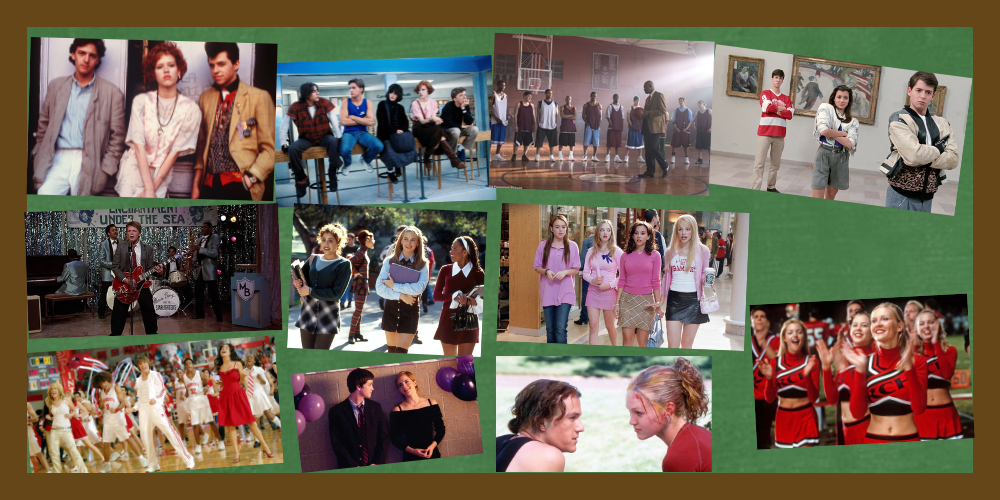
High school in real life rarely feels like the romanticized version that Hollywood creates. There’s no elderly Japanese veteran saving you from being bullied and teaching you ancient martial arts techniques; Saturday detention will not actually change your entire outlook on life, and people are, thankfully, not bursting out in heavily choreographed song and dance numbers. But just how different are the portrayals? Has Hollywood been lying to you for your entire life? (Yes, yes they have).

By far the biggest director of high school movies is the late John Hughes. Hughes was a legendary director, writer, and filmmaker known for movies such as The Breakfast Club, Sixteen Candles, Ferris Bueller’s Day Off, Home Alone, and Planes, Trains, and Automobiles. Unfortunately, Hughes lost his life in 2009 due to an unexpected heart failure.
Still, Hughes’ influence on Hollywood is undeniable. His films centered around the high school experience and teenage culture in general. Hughs’ films created several archetypes that still persist today in high school media. He truly captured what it was like to be in high school in the 80’s. But how accurate are his films really?
Hughes fairly accurately portrayed the different cliques of the time period. A large portion of this information comes from Dr. Kathleen Kollman who has a doctorate in American Culture Studies and is a professor at Miami University for film and pop culture related classes. According to Kollman, films like The Breakfast Club and Pretty in Pink focus heavily on the differences between social cliques and socioeconomic classes. These films also revolve around stereotypes in a high school setting, the jock, the princess, the rebel, the basket-case, and the brain. These stereotypes were somewhat accurate. They were based on real cliques and types of people, but were often exaggerated for comedic purposes.
However, Hughes’ movies do have a noticeable issue. In almost all of his movies, the cast is predominantly white. Many of his movies are located in the cosmopolitan city of Chicago, so the cast being all white is incredibly inaccurate. In the Hughes film Sixteen Candles, there is a Chinese exchange student named Long Duk Dong, which is a racist caricature of Chinese people. This is both stated by Kollman and a 2008 article on the character published by the National Public Radio (NPR). Also stated by Kollman, is that female characters in 80s movies, especially Hughes films, tend to be oversexualized in comparison to male characters. Again, in The Breakfast Club, Claire is oversexualized by “the rebel” John Bender, who would later end up with her at the end of the movie. Unfortunately, these movies are a product of their time when it comes to diversity and representation.

But 80s high school movies were not entirely dominated by John Hughes. Other standout ones include The Karate Kid series, the first Back to the Future film, and Footloose. These are mentioned here because they do not try to be accurate to high school. Unlike the Hughes movies, the high school genre is a subgenre to these movies. However, the plot still revolves around the high school setting. For example, in The Karate Kid the “new kid in town” Daniel Larusso is bullied by tough guy Johnny Lawrence over the love of Johnny’s ex-girlfriend Ali Millis. Bullying and teenage romance are common elements of other high school movies and the plot of The Karate Kid revolves around those ideas. The movie is mostly accurate for the time, except for the fact that people take karate incredibly seriously in this movie and Mr. Miyagi will not be able to stop your bullies for you by teaching you a special kick.
A common trend amongst all 80s high school movies is having a mostly happy ending. In The Breakfast Club, the five teens all connect by the end of the movie and some of them end up dating one of the others. In The Karate Kid, Daniel beats Johnny at the All-Valley Karate Tournament with the crane kick, ends up with Ali, and Mr. Miyagi gives him a proud look. In Ferris Bueller’s Day Off, Ferris successfully avoids authority and makes memories that will last a lifetime (but please don’t skip school!). It’s clear that 80s high school movies mostly have happy endings.
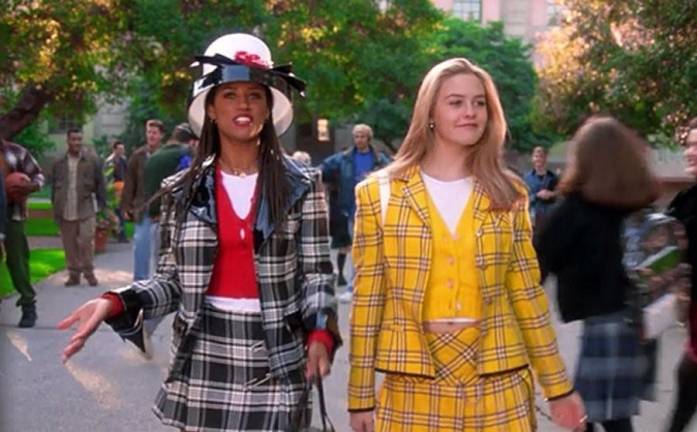
As high school evolved, films about high school had to evolve with it. Key high school movies from this era include Clueless, She’s All That, 10 Things I Hate About You, Never Been Kissed, and Dazed and Confused. One of the biggest differences between 80s and 90s high school movies is the diversity of the cast. While 80s high school movies had largely white casts with the few characters of color being racial stereotypes, 90s movies began having more diverse casts. For example, in Clueless, the main character Cher has an African-American best friend who is an important character throughout the movie. Also in Clueless, the protagonist female is socially intelligent and overall a strong character without being too overly sexualized. This is a stark difference from the 80s Hughes movies.
90s high school movies were also different in their humor. 90s high school movies were often raunchier with their humor. This is best seen with movies such as Dazed and Confused and American Pie, which are both rated R but still follow high school characters and plots. These movies also more openly talked about serious topics such as teenage sex and drugs. While movies like The Breakfast Club mention teenage sex, it’s played off as a joke. Movies such as Clueless and 10 Things I Hate About You deal heavily with teenage sex and other grittier topics.
Like the 80s, 90s movies tended to have happier endings. Usually, 90s movies all led up to a big event, such as a dance, a big game, or a grand gesture. For example, She’s All That and 10 Things I Hate About You both culminate in a big dance at the end of the movie with a nice, romantic gesture involved. Varsity Blues, a film about high school football, of course, ends in a big game. All of these films have happy endings, leaving the audience with a good feeling inside.
Like with the 80s, it is not accurate to say that 90s high school movies reflect an accurate portrayal of high school in the era. The films accurately portray the social structure of a high school and the fashion, but that’s where the accuracy ends. In real life, cliques were not nearly as strict as they were portrayed. In film, usually for the sake of an interesting story, cliques are treated as castes. Also, high school films of this era still do not fully represent the diversity of the cities they take place in. While it’s definitely an improvement over 80s films, it’s nowhere near correct.
At the beginning of the 21st century, films revolving around high school began to change once more. Key films from this era include Mean Girls, High School Musical, High School Musical 2, Freedom Writers, Coach Carter, She’s The Man, Remember the Titans, Superbad, Napoleon Dynamite, and Bring It On.
The biggest difference in this era of high school film is the technology. Characters in these films began to have their own cell phones, albeit obviously much less advanced than we have today. This tech begins to influence the characters’ motives, personalities, and often adds a sense of drama to the films. In A Cinderella Story, the main character Sam Montgomery connects with an anonymous boy online who is actually her high school’s star quarterback. As seen here, the internet and new technologies begin to serve a purpose as a plot device to set the story into motion.
Another big difference from 90s movies is 2000s films having less edgier humor. This is likely due to the tragic Columbine School Shooting of 1999 still being fresh on the mind. Not to mention, in 2001, another national tragedy struck in the form of 9/11. These events heavily impacted the film industry, and that can be seen with high school movies. There were certainly exceptions to this rule of course, such as Superbad, but this is again, an exception, not the rule. Even films like Mean Girls had less edgy humor when compared to earlier films of the same genre like Heathers.
According to Kollman, after the tragedies of both 9/11 and Columbine, less comedic teen movies were created as a whole. In 2001, the film Donnie Darko was released, which follows a troubled teenager navigating high school while being heavily bullied. Kollman believes that it was likely a response to the Columbine Shooting, given the depiction of bullying and how it mirrors 80s and 90s high school movies.

Another shift from the 90s is the rise of more inspirational teenage movies, especially ones about marginalized communities. In a post-Columbine and 9/11 America, the country was desperate for hope. People were terrified after just one national tragedy, but a second tragedy only two years apart was terrible for people’s anxiety. Because of this, Hollywood began producing movies that were hopeful. For example, Coach Carter, Remember the Titans, and Freedom Writers all deal with a school staff member teaching students of lower socioeconomic classes and marginalized communities that there is more to life and about unlocking their potential. Coach Carter, for example, is about a high school basketball coach in a rough neighborhood helping his team not only become champions but also helping his students pursue a life beyond sports, leading to most of his team graduating. While the team does not win their final game, the ending is incredibly uplifting and hopeful.
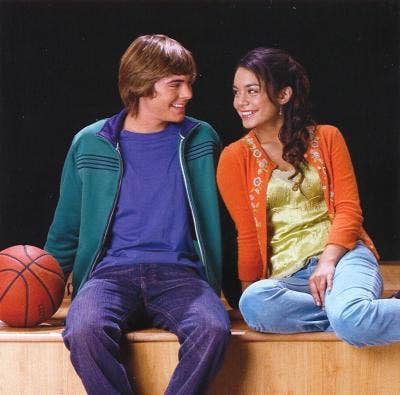
Perhaps the high school film of the 2000s is High School Musical. Released in 2004, High School Musical launched the careers of stars like Zac Efron, made over one hundred million dollars in DVD sales, and launched an entire franchise. But is it accurate? No. Not in the slightest. People do not take theater as seriously in real life, no one cares about stereotypes nearly as much, and people are not singing and dancing in the hallways every other hour. It is an incredibly fictionalized and highly idealistic portrayal of high school. No one in this movie feels any sort of academic stress and real-life high schools are nowhere near as pristine.
2000s high school films are not more accurate than 90s films, but they are also not less accurate. They are better in terms of diversity, with movies like Coach Carter having a predominantly black cast and Remember the Titans dealing directly with racism. The technology is more accurate as well. But the inspirational wave in the 2000s definitely makes reality seem simplistic. While inspirational high school films were often based on a true story, they are not something that is experienced in every high school. The true stories are cherrypicked by Hollywood to uplift audiences.
The final decade I will cover is the 2010s, as the 2020s are only halfway over, so it is not fair to have an in-depth discussion of the decade. Key films from this decade (2010s) include Easy A, The Perks of Being A Wallflower, Paper Towns, Love, Simon, and The DUFF.
Common topics in this era of film include bullying, peer pressure, and the rise of social media and its impact on students’ lives. Teenage struggles, such as anxiety or depression, were commonly portrayed in this era as well. A big difference from earlier decades is that there’s few “big events” to end the movie. While every film has a climax, there’s no dances and no grand love confessions from one character to another. High school movies in this era are more realistic in this sense.
By far the biggest difference from earlier decades is the diversity. There’s more openly LGBTQ characters, more characters of color, and more strong, female protagonists. On top of that, these characters are not defined by their race and aren’t caricatures of racial stereotypes. Even in 2000s films like Mean Girls, there are several jokes that rely on outdated stereotypes about the community. While the jokes weren’t considered problematic at the time, it’s important to note that the 2010s began to shift towards a better representation of marginalized communities.
There are not many differences between the 2010s and 2000s besides the increase in diversity. The themes continued and the themes are mostly the same. However, the portrayal of high school definitely improved its accuracy in this decade. Characters are more complex, the Hughes era stereotypes began to die out, and social cliques are much more fluid.
As stated before, I interviewed Dr. Kathleen Kollman of Miami University’s Film Department to gather research on this topic. In her view, high school films have evolved to be more inclusive and have greater expectations of complex storytelling when compared to films from earlier decades. Kollman believes “Audiences today seek more egalitarian portrayals of gender and diversity, and a high school film produced in 2025 would likely seek to better unpack some of the socioeconomic class issues that films of the ’80s and ’90s merely touched on without fully resolving.”

I asked Kollman to choose one film from the pre and post 2000s as a representative of films of the time period. For the pre-2000s, she chose Pretty in Pink due to its soundtrack, fashion, and story. As for the 2000s and beyond, she chose the musical version of the classic Mean Girls for the same reasons as Pretty in Pink but for a modern audience. Just for fun, I also asked Kollman for her favorite high school movie, to which she responded Valley Girl due to a young Nicolas Cage’s stellar performance and the “less polished” feeling when compared to other movies of the decade. Personally, my favorite high school movie is Coach Carter due to Samuel L. Jackson’s incredible performance as Coach Ken Carter and the inspirational feeling I get when watching it.
Overall, high school movies tend to not be realistic. This has been a common trend ever since the 80s with John Hughes and the Brat Pack. However, high school movies, while there are certainly less of them released now, are getting more realistic with the evolving portrayals of academic stress, bullying, and other problems teenagers face in high school. Now, next time you watch a movie set in high school, think to yourself, “Is my life really like this?” Chances are, probably not.