






















It’s mid-September and your mom just asked you to get her a pair of socks. You drudge up the stairs and into her room, opening drawer after drawer looking for compression socks. You open the top drawer and riffle through it, searching for her stupid heart-pattern socks and there they are, hidden beneath a mountain of scarves: the elves, Buddy and Pickles, definitely not at the North Pole where they’re supposed to be.
Santa; the greatest lie we were ever told. But when did we find out about the lie? And why did we ever believe in the first place?
A History of Santa
Most of, if not all of us, have at least heard of Santa Claus; by that name or another. But who is he, and where did he come from?
Believe it or not, Chris Kringle was a real person. But that wasn’t his name. His name was St. Nicholas, and he was a 4th century Greek saint. According to The Public Domain Review, he is most known for providing three women with dowries (basically getting them married), so that they didn’t become subject to the career of most single women during the time period. The legend of Santa though, originated from his reputation of secret gift giving, and his status as the patron saint of children.
The reindeer and elves come from the beliefs around the Dutch version of St. Nicholas, who was legend to have rode over rooftops on a large white horse, and had mischievous spies who listened down chimneys to discover whether children were being naughty or not. Creepy, right?
Over the years, St. Nicholas evolved into Father Christmas, a figure of English folklore established around the 15th century. But St. Nicholas resurfaced after the Revolutionary War, and was promoted to patron saint of society and city. On December 6th, 1810, the New York Historical Society hosted the first St. Nicholas anniversary dinner. There, was Alexander Anderson, who drew “Sancte Claus”, depicting St. Nicholas in front of a fireplace covered in stockings.
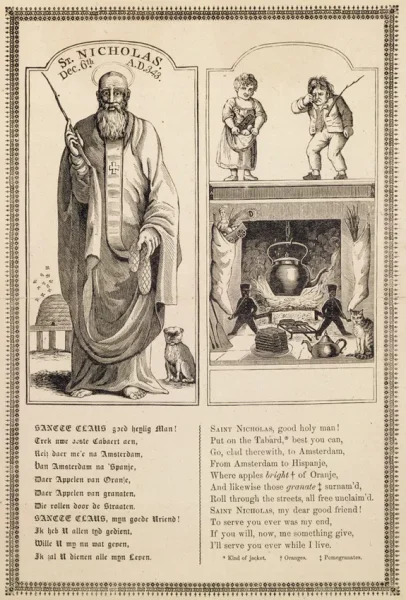
https://commons.wikimedia.org/wiki/File:St_Nicholas_by_John_Pintard_(1810).jpg
From there, the idea of “Santa Claus” really took off. In 1822, Clement Moore wrote a poem now known as The Night Before Christmas. Cartoonist Thomas Nast developed most of the imagery for Santa Claus, including the sleigh, the reindeer, as well as the idea that Santa’s workshop is in the North Pole. But it was Frank A. Nankivell’s illustration of Santa in 1902 that solidified the red suit depiction.
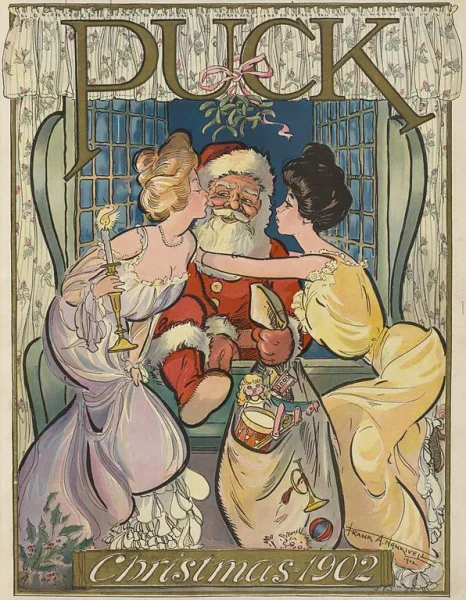
https://commons.wikimedia.org/wiki/File:Santa1902PuckCover.jpg
How Harrison Found Out
So says my data, 100% of students at Harrison celebrate Christmas, which isn’t surprising considering our demographic. 100% of students’ parents implied the existence of Santa and encouraged a belief in him. Not all parents do so, though. WHHHS’s BioEd teacher and HOSA advisor Ms. Abel, who doesn’t have children yet, expressed, “I would not feed into the myth of Santa Claus”. Her reasoning: that she, like her mother, doesn’t believe in lying to children.
This raises the interesting idea that the dishonesty concerning Santa’s existence is harmful to children, in addition to a lot of parents not wanting to come across to their children as “liars”, Psychology Today finds that most people who were lied to as children lied back to their parents. But, even though this is true, most children have a positive reaction to learning the truth about Santa, and they don’t hold a grudge about it. (so you don’t have to worry about turning your kids into little liars, or ruining your relationship)..
According to The Guardian, children generally stop believing in Santa around the age of 8, which is also congruent with the results of my survey. Psychologists determined that the most common crusher of the fantasy was non-believer testimony. Psychology Today states that the belief in Santa promotes a healthy sense of fantasy for children. It endorses the child’s imaginations, and in the cases of children who figure it out on their own, their problem solving and logic skills. Mrs. Pantazi agrees. She believes that “when done correctly, and at the right age,” believing in Santa is not harmful to kids imaginations or sense of trust.

Of the students who were told (28% of students), one student in particular had a very interesting story to tell. Junior Gwyn Hill shared that an unnamed friend of hers hid a camera under their Christmas tree, where they caught their dad putting presents under the tree. But rather than taking the hint, and realizing that Santa isn’t real, Gwyn went on believing that her friend’s dad was Santa, until that friend expressed that he was not.
Most of the kids who figured it out on their own (72%) did so through common sense. Hilariously, the most common “sense” kids came to, was the logistics of a man of Santa’s size (large) fitting in their chimney. The second most common way of finding out was by association, particularly when students found out about the Tooth Fairy. I suppose the busting of the Tooth Fairy unveiled all of the other conspicuous individuals of our childhood as well.
Santa is a really nice way to keep the magic alive for children all around the world. But everyone finds out sooner or later. Do you think it’s worth it to tell them he’s real at all? Let us know!


.jpg)
