






When you hear the word “Valkyrie” what do you think of?
Do you think of fierce winged warrior women or softer spirits that guide warriors to the other side?
“Then glittered light | from Logafjoll, // And from the light | the flashes leaped;
High under helms | on heaven’s field; // Their byrnies all | with blood were red,
And from their spears | the sparks flew forth.”
. . . . . . . . . .
“From heaven there came | the maidens helmed,– // The weapon-clang grew,– | who watched o’er the king;”
These lines from Helgakvitha Hundingsbana I, a poem of the Poetic Edda, illustrates Valkyries arriving at a battle to choose its victor. More specifically, the battle where Helgi Hundingsbana fights to win his love, the valkyrie Sigrún, from her arranged husband.
This is but one example of the Valkyries in actual mythology. And although their depiction is varied, these maidens are responsible for casting the die of fate and weaving the very concept of victory. And they have been carried into modern culture bearing sword and spear, prepared to issue fate.
Introduction & Etymology
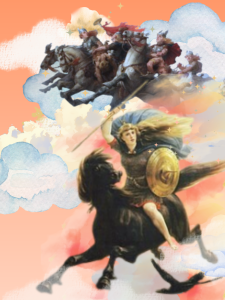
According to EBSCO, Valkyries are “revered female warrior figures who play a crucial role in determining the fate of fallen warriors during battle.” Merriam Webster defines them as “any of the maidens of Odin who choose the heroes to be slain in battle and conduct them to Valhalla.”
In short, they pick up the souls of dead guys for Odin, saving the war god an extra trip.
The fact remains, Valkyries are 1. Women. And 2. very important. But most importantly, their interpretation has changed with time.
Their name is quite literally their purpose; Valkyrie originates from the old Norse word ‘valkyrja’, which is constructed from “valr” (“the slain”) and “kryja” (“chooser”). Making valkryja mean “chooser of the slain”. Its old English cognate, wælcyrge, has similar meaning and also can translate to “raven”. Valkyries have also been called óskmey (“wish-maid”) and “Odin’s maids”.
CHOOSERS OF THE SLAIN
“… These are called Valkyries. Odin sends them to all battles, where they choose those who are to be slain, and rule over the victory.”
Gylfaginning (pronounced GIL-vah-gin-ning) from the Prose Edda, dated to the 13th Century. Written by Snorri Sturluson.
Valkyries most often are depicted as instruments of Odin in some shape or form. They ride to battle and determine the victors and alongside Freya pick half of the slain (as stated in the Grímnismál)
“‘Fólkvangr is the ninth, and there Freyja decides // the choice of seats in the hall; // half the slain she selects each day,”
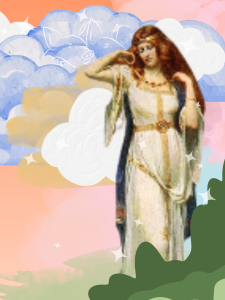
The Valkyries guide the souls of chosen warriors from the battlefield to Valhalla, where they will prepare to fight alongside the All-Father, Odin in the final battle, Ragnarök. From this one can assume that Odin has authority over the Valkyries.
Their association is backed up by a variety of sources. One example is located in the Voluspa, Stanza 30, “From far I saw the Valkyries coming // ready to ride to the hero host… // Numbered now are the Warfather’s maidens, Valkyries, ready to ride o’er Earth.” (This is specifically Olive Bray’s 1908 translation.) “Warfather” is in reference to Odin.
More specifically, in the Hákonarmál (pronounced: “HAH-koh-nahr-mahl”), Odin sends down two of his Valkyries, Gǫndul and Skǫgul to receive Norwegian King Hákon the Good at the battle of Fitjar.
“The god of the Gautar [ODIN] sent Gǫndul and Skǫgul to choose among kings, which of the kin of Yngvi should go with Óðinn and live in Valhǫll.”
Gǫndul and Skǫgul are present until the battle reaches its conclusion and they seek out King Hákon.
“Gǫndul said that [this], leaned on a spear-shaft: ‘The gods’ force grows now, since the gods have invited Hákon home with a great army.’’
King Hákon then questions the Valkyries ‘‘Why did you decide the battle thus, Spear-Skǫgul, though we were [I was] worthy of victory from the gods?’ ‘We brought it about that you held the field and your enemies fled.’’
Skogul responds ‘‘We two shall ride,’ said the mighty Skǫgul, ‘through the green abodes of the gods, to say to Óðinn that now a supreme ruler will come to look on him in person.’’
Throughout this, Gǫndul and Skogul are referred to respectfully and as authority figures. In the eleventh stanza “‘The leader heard what the renowned Valkyries said from [on] horseback;” And although mildly frightened by their presence, Hákon listens to them “they behaved prudently and remained, helmeted, and held shields in front of them.’”
This depiction of Valkyries aligns more with our modern view of them. Next up is the real deal.
“The Song of The Valkyries”
“It is horrible now to look around
As a blood-red cloud darkens the sky.
The heavens are stained with the blood of men,
As the Valyries sing their song.”
(Excerpt from the Anonymous poem, Darraðarljóð.)
You already know Valkyries pick who lives and who dies in battle. This is illustrated (and immortalized) best in the anonymous poem Darraðarljóð (pronounced: Dahr-rah-thar-lyohth), otherwise known as “The Song of the Valkyries”. This poem depicts the Battle of Clontarf in 1014 and is best read:
“Blood rains from the cloudy web
On the broad loom of slaughter.
The web of man grey as armor
Is now being woven; the Valkyries
Will cross it with a crimson weft.
The warp is made of human entrails;
Human heads are used as heddle-weights;
The heddle rods are blood-wet spears;
The shafts are iron-bound and arrows are the shuttles.
With swords we will weave this web of battle.”
(Fully Accessible & Translated Version at The Viking Answer Lady and The Skaldic Project)
Interesting, right?
This poem received a variety of responses, most of which grazed abject horror and morbid curiosity. The first words that left Brooklyn Camper, a Juniors, mouth were “-Are they… Killing people?”
Yeah, they are killing people. The twelve Valkyries in Darraðarljóð are weaving fate itself. Much like the Greek Moirae/ Fates (Think: The Old ladies squabbling over an eye in Disney’s Hercules) Their weaving is not just a literal task but a symbolic act, sealing the destinies of those involved in the conflict.
“Let us now wind the web of war
Where the warrior banners are forging forward
Let his life not be taken;
Only the Valkyries can choose the slain.“
This is reminiscent of the three Norns, who weave fate. Darraðarljóð merges weaving and battle, and raises the question of if there is any glory in this battle. Or if it is merely carnage.
“The men of Ireland will suffer a grief
That will never grow old in the minds of men.
The web is now woven and the battlefield reddened;
The news of disaster will spread through lands.”
While Brooklyn reacted with tired, abject horror, my friend Natalie was far more calm. Taking a moment to think, she quietly declared “This doesn’t feel malicious.”
Because yes, although the Valkyries are inherently portrayed as maidens singing the tune of war, winding intestines, spears, and broken bodies into their twisted weave, they are doing their duty.
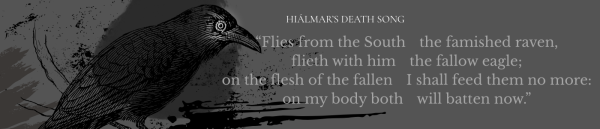
The “Raven’s Song” / “The Lay of Harald”
“‘Let sword-bearers listen, while I recount feats of weapon-points concerning Haraldr the exceedingly wealthy. I shall recount the words that I heard a white, bright-haired girl when she spoke with a raven.’”
The Hrafnsmál (Pronounced: hr-ah-fnsmal) or Haraldskvæði (Pronounced: Hah-ralds-kvai-eh) is a 9th century (fragmentary) Skaldic praise poem. An anonymous speaker recounts what he has heard while passing a valkyrie and raven. The Valkyrie is unnamed, just as the bird she speaks to.

The two go back and forth: the Valkyrie questions and the Raven responds in turn. These mainly focus on the deeds of King Harald I of Norway.
“‘The Valkyrie thought herself wise; men were not pleasing to the aggressive maid, who understood the voice of the bird. The white-throated and the bright-eyelashed one greeted the skull-picker of Hymir which sat on the edge of a cliff.’”
But there is a sharp disparity in the portrayal of each party in the Hrafnsmál.
‘‘What is the matter with you, ravens? From where have you come with gory beaks at break of day? Flesh hangs from your claws; the stench of carrion comes from your mouths; I think you lodged last night near where you knew corpses were lying.’’
The Valkyrie, fair and well-kept is in sharp contrast to the filthy, bloodstained raven bedecked in gore. Yet they both speak calmly and respectfully to each other. In the 20th Stanza, the Valkyrie speaks ‘‘I want to ask you about the equipment of berserks, taster of the corpse-sea what provision is made for war-daring men, those who surge into battle?’’
The raven responds “‘They are called wolf-skins, who bear bloody shields in combat; they redden spears when they come to war;” furthermore “There, I believe, he, the sovereign wise in understanding, may entrust himself to men of courage alone, those who hew into a shield.’’
This banter continues for a good bit but the radiant Valkyrie speaking to the bloodied raven is best understood with the knowledge of ravens in Norse mythology.
“Two ravens sit on his shoulders and speak into his ear all the news
they see or hear… He sends
them out at dawn to fly over all the world, and they return at
dinner-time.”Prose Edda, page 38-9
The Raven brings to mind Huginn and Muninn, the two ravens that traverse the world to give Odin knowledge of its dealings. Their names roughly mean “mind and will”. Odin enchanted these two birds with the ability to fly fast, understand, and speak any language. These clever birds are often used in kennings for Odin but the Norse focus on their status as Carrion birds.
Ravens are often referenced in Valkyrie kennings. Some examples would be gagl gunnar or “of Gunnr’s Gosling”, “gull of the sword-girl”, and finally “the hawk of Hildr” or Hildar Haukr. Ravens and their dealings with the Valkyries cemented them as Odin’s “eyes and ears” and the hungry, albeit wise scavengers of the battlefield.
Kennings & “Why are they named that?”
Until now, you’ve been introduced to a couple Valkyries. Fair Sigrún, calm (and mildly perturbing) Gǫndul, wise Skǫgul- all of these maidens have created the vision of a respectable maiden with great power. But I know you’re asking the question “WHAT DOES THAT MEAN?”
A Kenning is “a figure of speech in which two words are combined in order to form a poetic expression that refers to a person or a thing.”. Kennings are built up of a base word and a determinant. When you are referring to the sea as the ‘whale’s road’ you are using a kenning. Likewise, ‘Skyscraper’ is an example too. It’s important though, to remember that kennings are formatted specifically to have more words than necessary.
How does this relate to Valkyries? Valkyrie names usually relate to battle or combat, and in some cases, spears (Odin’s signature weapon). Their names act often as determinants in kennings for battle, weapons, ravens, and warriors.
This is reflected in various poems where their names are used as a kenning for weapons and battle. For example, the “rumbling blizzard of Hildr” refers to arrows, while “the frost of Mist” is a sword. Likewise, “Cloud of Skuld” and “fierce sky of Gondul” are kennings for a shield.
That being said, to understand some of these kennings you need to know the meaning of the Valkyries names. Of the twelve Valkyries present in Darraðarljóð, only six are named. So we will start with them.
“‘Hildr goes to weave, and Hjǫrþrimul, Sanngríðr, Svipul, with drawn swords.”
First mentioned is Hildr, the weaver, her name means “Battle”.
Outside of Darraðarljóð, Hildr is present in the Hjaðningavíg (pronounced: YATH-ning-a-veeg), where she is the daughter of King Högni and the wife of king Hedin. Hildr was abducted by Hedin while her father was away, creating a feud that led the two kings to battle on an island. Each day, Hildr raises the dead to continue the two king’s never-ending battle until Ragnarök. What a woman!
After Hildr is Hjǫrþrimul (“Sword Battle Noise”), Sanngríðr (“Very Violent/Very Cruel”), and Svipul (“Changeable”).
“Let us now wind the web of war
And then follow the king to battle
Gunn and Gǫndul can see there
The blood-spattered shields that guarded the king.”
They are then followed by Gunnr (“War/Battle”) and Gǫndul (“Wand-Wielder”), who also had a role to play in King Hedin and Högni’s never-ending battle. Gunnr is frequently apart of kennings for battle; for example “storm of Gunnr” and “clamour of Gunnr”.
There are multiple sources which provide a list of the Valkyries. But right now, we will focus on the Grímnismál, which provides a list of Valkyries serving mead to the Einherjar.
“Hrist and Mist I want to bring me a horn, // Skeggjǫld and Skǫgul, // … and Þrúði, // Hlǫkk and Herfjǫtur, // Gǫll and Geirǫlul,// Randgríð and Ráðgríð and Reginleif;”
Hrist (“Shaker”), Mist, Skeggjöld (“Axe-age”), Skǫgul (“Shaker”), Thrud (“Strength”), Hlökk (“Noise/Battle”), Herfjötur (“Host-fetter”), Göll (“Tumult, Rumble.”), Geirölul (“The one charging fourth with the spear”), Randgriz (“Shield Destroyer”), Radgridr (“Council truth; the bossy”), Reginleif (“Power trace; Daughter of the Gods”).
Other notable Valkyries include Brunhilde (pronounced ““Broon-hil-duh”) whose name means “Battle Armor”. Sigrun means “victory rune”, and is pronounced “SEEG-roon [‘oo’ like in “foot”]”). Finally, the youngest of the three Norns, Skuld (pronounced “skuhld”) translates to “Debt, Obligation” or “Future”.
There are many more Valkyries mentioned throughout Norse mythology, totaling in at the very least thirty-nine different maidens. If you’re interested in more Valkyrie names, here’s a list of names and their translations.
Handmaidens & Hosts
(They aren’t just crazy murder ladies! ☆(≧▽≦)☆)
“There are also those others whose office it is to serve in Valhall, to bear drink and mind the table-service and ale-flagons;”
Gylfaginning (pronounced: GIL-vah-gin-ning), Page 47
Determining fate was not the only duty left to the Valkyries, they also had to maintain the homefront. And by that I mean, all of the guys they bring to Valhalla.
In the Grímnismál (pronounced: GREEM-nees-mahl), a disguised and very miserable Odin, in deep despair, laments
“Hrist and Mist I want to bring me a horn, // Skeggjǫld and Skǫgul, // Hildi and Þrúði, // Hlǫkk and Herfjǫtur, // Gǫll and Geirǫlul, // Randgríð and Ráðgríð and Reginleif; // they bring ale to the unique champions.”
By unique champions, Odin refers to the Einherjar, or the Valkyries chosen warriors.
The Einherjar (pronounced “ane-HAIR-yar”; think of the first syllable like “sane” without the “s”) live a lavish, enviable lifestyle in Valhalla. They are the warriors chosen by the Valkyries and brought to Valhalla. There they are subject to countless feasts and endless battles. So pretty much “Eat, Sleep, Fight, and then Fight some more”; Fun!
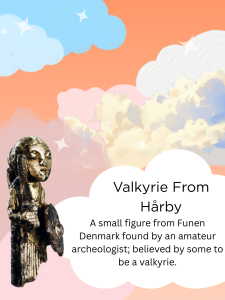
In short, the Valkyries act as hosts and take care of the Einherjar. Plenty of Viking art reflects a woman bearing a drinking horn. And plenty of carvings are believed to detail a Valkyrie presenting a drinking horn. The ‘women of the fray’ are also skilled caretakers.
I asked Natalie Douglas, a Junior at Diamond Oaks what she thought when she heard the word Valkyrie she responded “… “When I hear the word Valkyrie I think of a loyal protector or somebody who fights for somebody else.”
Knock, Knock (It’s Christianity)
Although the majority of Europe had converted to Christianity, the Vikings remained fond of their own gods and stories. Early missionaries in the 700s and 800s had their work cut out for them, but they eventually succeeded in bringing Christianity to Scandinavia. This was in part because it was favorable for trade and the threat of the German Empire.
The transition to Christianity was gradual and very slow, but this progress was built off the Vikings ability to believe in multiple gods. The Vikings regarded Christianity as supplementing their gods rather than overwriting them. Through this, both religions could coexist without completely abandoning one or the other.
Here’s an example of a poem from this period, the Harmsól, dated to the 12th century. Harmsól (pronounced: Harim-sowl) translates to “Sun of Sorrow” and was written by Gamli kanóki.
“You, the one Christ, command trees of the snake of Mist <Valkyrie> [SWORD > WARRIORS] to enumerate all their faults with repentance before learned men; and you promise straight away to men, excellent warden of the high path of the storm”
Aside from the oblivious reference to a Valkyrie, Mist, the Harmsól betrays much trouble in the speaker’s life. It is intended as a praise poem to Christ. But the author, Gamli, addresses human inadequacy, highlighting his own failures and shortcomings. The Harmsól really is fascinating and I couldn’t cover it in it’s entirety.
‘The world, which I thought steadfast as a friend, is fickle; it darkens men’s behaviour; people on earth … become rich in sin.” (Stanza 55)
Thus, it is important to note that Later Norse Mythology differed from Paganism, its predecessor. But it still retained some of its elder’s beliefs. The depiction of Valkyries shifted with the arrival of Christianity too. They became both a symbol of carnage and dutiful shield-maidens. Valkyries become more human, even appearing as the lovers of heroes (think Sigrún or Brunhilde.)
Human? Valkyrie? Who knows!
Overtime Valkyries became more and more human, becoming the lover of heroes and wise guardians.
In the Heroic poems, there is a format to the Valkyries. They are often born to human families, most often kings (Think Hildr), travel on horseback, and are in some aspect war-like.
My favorite example is Sigrún (remember her?). Described as “Hogni’s daughter” and of some sort of noble blood, Sigrún is a Valkyrie who encounters King Helgi. Throughout Helgi’s journey Sigrun watched over him and his men “But from above | did Sigrun brave Aid the men and | all their faring;” And Helgi is ultimately victorious, and Sigrún faithfully comes to announce the victory.
‘‘Unharmed, prince, you shall profit from men, // …and enjoy life, // since you have felled the flight-averse boar, the one who caused the death of a frightful one!
And for you, Buðli’s descendant, are most befitting // both red rings and the mighty maiden!
Unharmed, Buðli’s descendant, you shall enjoy both // Hǫgni’s daughter and Hringstaðir,
// victory and lands — then the battle is concluded!’ “
Helgakvitha Hundingsbana I, Stanzas 55 and 56
Humorously, Helgi asks Sigrún if she and her fellow maidens will come home with him and his warriors- and Sigrún quite literally says she has better things to do when they first meet.
“And from her horse Hǫgni’s daughter —
the din of shield-rims subsided — spoke to the prince:
‘I think that we have other tasks
than to drink beer with the ring-breaker.”
Helgakvitha Hundingsbana I, Stanza 17
There is another Valkyrie who is described as being the daughter of a king, Brunhilde.
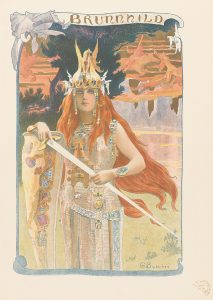
Brunhilde (otherwise known as Brunhild, Brynhildr, or Brunhilda) is a prominent Valkyrie in Norse mythology.
In the earliest version, Brunhilde is referred to as Sigrdrífa (pronounced: “sig-er-dree-vah” or “si-guhd-rifuh”) which means “driver to victory”. Sometimes a contrast is made between Brunhilde and Sigrdrífa, but the two are generally identified together.
In the Völsunga saga Brunhilde is described as being the daughter of King Bundli. Alongside a shield-maiden and Valkyrie.
Brunhilde is sent by Odin to decide a battle between heroes. Odin had promised victory to one of them. But Brunhilde chooses the other. Infuriated, Odin decides that Brunhilde must be punished. Her punishment? Marrying a mortal man.
“Sigrdrifa, slew Hjalmgunnar in the battle, and Othin pricked her with the sleep-thorn in punishment for this, and said that she should never thereafter win victory in battle, but that she should be wedded.”
Sigrdrífumál ((“The Ballad of the Victory Bringer”)) (pronounced: SIG-rdree-foo-mahl) otherwise known as the Brynhildarljóð
Brunhilde responds “thereagainst I vowed a vow, that never would I wed one who knew the name of fear.” (Völsunga Saga, Chapter XX, “Of Sigurd’s Meeting with Brynhild on the mountain”)
This leads to Brunhilde being sealed away inside a castle surrounded by a ring of fire in a deep sleep (pricked by the sleep thorn) and the hero Sigurd to come to her aid. Sigurd and Brunhilde talk of runes and Brunhilde bestows Sigurd knowledge.
“Sigurd spake now, ‘Sure no wiser woman than thou art one may be found in the wide world; yea, yea, teach me more yet of thy wisdom!'”
Long story short, Sigurd says “Zoo-wee mama!” and proposes to Brunhilde with the magic ring Andvaranaut (pronounced: AND-vah-rah-noht) and leaves her in the castle. Sigurd travels to the court of King Gjuki, unaware that the Queen Grimhild is 1. a sorceress and 2. wants Sigurd to marry her daughter, Gudrun. So Grimhild prepares a potion that made Sigurd forget about Brunhilde. Sigurd married Gudrun and Grimhild sends Gudrun’s brother, Gunnar to go court Brunhilde, but he is stopped by the ring of fire.
Still under Grimhild’s spell, Sigurd helps Gunnar win Brunhilde’s hand through deceit (disguising himself as Gunnar and entering the ring of fire) and marries her. Sigurd takes back the magic ring and gives it to Gudrun. All is well until Gudrun and Brunhilde argue over whose husband is greater eventually resulting in Gudrun revealing that it was actually Sigurd who entered the ring of fire, not Gunnar.
Incensed and humiliated, Brunhilde rallies her husband Gunnar and his brother Hogni to kill Sigurd but the two trick their younger brother, Gutthorm into killing Sigurd by giving him a magic potion. Sigurd kills Gutthorn but his wounds take him.
The tale ends with Brunhilde throwing herself upon Sigurd’s funeral pyre, sending the two lovers to Hel and marking the end of both Sigurd and Brunhilde. This story is the tragic basis for Wagner’s epic opera cycle, so next, let’s take a trip to the 19th century.
Hello Romantic Era!
In the 19th century mythology was “in vogue”. Harrison’s sophomores likely recall “A Modern Prometheus”, or the alternate title of Mary Shelley’s Frankenstein. In this case, the comparison of narcissist Victor Frankenstein to Prometheus is very deliberate. Victor and Prometheus reach too far and bear the consequences- Prometheus chained to a rock doomed to have an eagle eat his liver daily for giving humanity fire. While Victor was left to watch his life, and the life of his loved ones fall apart for stealing the act of creation. (This ignores Prometheus’s good intent, in helping humanity as opposed to Victor, who’s pride blinds him from foreseeing the consequences of his actions).
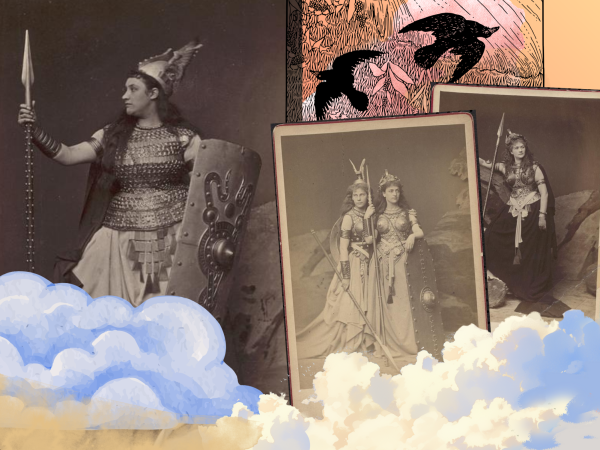
The Romantic era birthed the image of almost angelic figures in the visage of a woman. Shrouded in light, guiding warriors to the afterlife. Perhaps riding upon a snow-white winged horse or holding a sturdy shield. These maidens are shown not heading to battle, but in moments of calm, awaiting warriors to escort to the other side.
Valkyries received many a symbolic depiction during the 19th century. Valkyries became a symbol of death and victory in Germanic countries. To the point of being used to push the idea of a ‘glorious death for ones nation’. Because the valkyries were so intertwined with the concept of glory, death, and battle- they became a great symbol for a national identity.
_by_Arp%C3%A1d_Basch_(1900).jpg)
Árpád Basch (1873-1944), Public domain, via Wikimedia Commons
When the Romantics ‘rediscovered’ Norse mythology they took its hand and ran forward. To the point that some have dubbed it a “Viking revival”. And as a result, valkyries were further humanized. Artists painted fair, plump, rosy-cheeked maidens with long golden-hair and clothing that may or may not be appropriate for battle.
Riding on the tail-end of the 19th centuries obsession with Old Norse mythology, Richard Wagner (Pronounced: V-agner. With a V) brought valkyries back into the limelight with his four German Epic Operas ‘Der Ring des Nibelungen’ (The Ring of the Nibelung). The second act, Die Walküre focuses upon the hero Siegfred (Still Sigurd; just a slightly different name) and the valkyrie Brunhilde. Although you likely recognize its iconic piece ‘Ride of the Valkyries’ which was played during a helicopter attack in 1979s Apocalypse Now.
Wagner’s epic tells the story of Brunhilde and Sigurd, culminating in Brunhilde riding to the funeral pyre to join her love. And although Wagner’s story is not regarded for its accuracy to myths, it is notable in the fact it truly shone a light upon the valkyries. Wagner’s love for drama catapulted valkyries into the limelight.
Modern Portrayal of Valkyries
Alongside their fellow members of the Norse Pantheon, valkyries have been ushered into the present all over the world.
Notable examples would be Tessa Thompson as Valkyrie in Marvel’s Thor: Ragnarok and Avengers: Endgame. Or the actual Marvel comics character Valkyrie, who has went through many changes over the years.
In the Basketball world we have the Golden State Valkyries, a new member of the WNBA arriving in the 2025 season. Their website describing their Valkyries as “warrior women who are fearless and unwavering – flying through air and sea alike”, hence the name.
In Japan, we have Shuumatsu no Valkyrie (終末のワルキューレ), otherwise known as Record of Ragnarok. Which sets a hotheaded Brunhilde as the mind responsible for choosing the thirteen ‘greatest’ fighters of human history for the thirteen death battles that is their interpretation of Ragnarok. The ultimate goal being to secure seven victories and secure humanities fate against total divine annihilation.
In gaming, God of War takes the cake. During the game you can duke it out with nine Valkyries (and get curb stomped by Gondul). God of War has the warfather’s maidens helmed and armed… and capable of flatlining you.
Valkyries have traveled far and wide and undoubtedly secured their place in pop culture. And the varying portrayal of them is perhaps indicative of their changing roles and descriptions. Whether it be on the big screen through Tessa Thompson’s portrayal of Valkyrie in the MCU or the various Japanese interpretations of Valkyries- these maidens remain symbols of both strength and femininity.
I leave you off with a quote from Brunhilde from the Eddic Poem Helreið Brynhildar (‘Brunhilde’s Ride to Hel’)
“Ever with grief | and all too long
Are men and women | born in the world;
But yet we shall live | our lives together,
Sigurth and I. | Sink down, Giantess!”