

















“Invasive Species”
If you’ve been in a science class for more than ten minutes, you’ve probably heard the term thrown about time and time again.
And if you haven’t… well, if you’ve ever paid a visit to a zoo or fish and wildlife center you might recall a poster listing species employees are on the look for. Or, if you live in the continental US, you’ve definitely seen the weird not-ladybugs that break into your house every year and die in the most obscure spot, that no one ever checks but your mom when she suddenly gets the inspiration to clean.
And if you’re hip and with the youth, you know the guy from Florida who nabs animals up off the ground while on a morning walk, who walks through the everglades without shoes and calls alligator’s “sea puppies.” Yoink!
But what are invasive species?
An Intro to Invasive Species
Invasive species are first and foremost, non-native species. Non-native species or ‘introduced species’ are plants or organisms we have introduced to a new environment, accidentally or on purpose. For a non-native species think of cattle, livestock, and those ornamental trees your dad insists on trimming when they are very, very obviously at the end of their line. Either way- they get here.
Non-native species can have many uses for us- whether it be as regulators, food sources, biological control, etc. They can slow down land-erosion. For love of guac, they are probably (some of) the pretty flowers in your grandma’s garden!
Corn, a staple in many diets, is technically an introduced species across the globe- it came from the New World (The Americas) and reached the rest of the world through the Columbian Exchange alongside pumpkins, potatoes, and tomatoes. Corn filled bellies all over the world, able to grow in places unsuitable for tubers and grains while potentially having multiple harvests over the year. On the other hand, watermelons, yams, and rice came from the Old World.
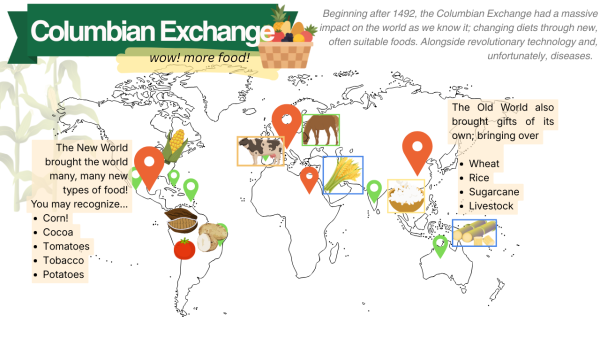
The problem? Food isn’t the only ‘friend’ shared in the Columbian Exchange… diseases hopped onto the bandwagon too.
We naturally can build up an immunity to certain diseases over thousands of years through natural selection. In essence, the guy who got snapped up by Smallpox can’t pass on his genes- but his wife, who survived it, can go on to have more children. Over time, this can create naturally more resistant individuals who pass on those genes. That being said, individuals who have never been exposed to these diseases have no such immunity.
In the New World, Native Americans, who lacked the arriving settler’s resistance became incredibly vulnerable, especially to Old World diseases like smallpox, measles, and Typhus. In fact, so many indigenous people died that some scholars have even dubbed this period “The Great Dying”.
That being said, your average cow is not an invasive species (even if they cause ecological destruction; looking at you, ruined fields) just as your usual dandelion isn’t typically considered invasive (don’t say that to an Alaskan, though).
What sets an invasive species apart from a normal, law-abiding non-native species is their impact.
An invasive species is defined in Executive Order 13751 as a “non-native organism whose introduction causes or is likely to cause economic or environmental harm, or harm to human, animal, or plant health” or in simpler words, the guy who comes into your house, leaves the stove on, and wonders why it burnt down.
Invasive species are dangerous because of the threat they pose to biodiversity- they outcompete or kill native species. Native species have resistance of some sort to local natural phenomena- but when you introduce a new guy that either A.) wants to eat them, or B.) wants to eat their food- these species have no natural protections. All bets are literally off the table. Because Larry the Termite and his termite buddies ate the table after hitching a ride with some friends.
Invasive species also, in new environments, lack the natural predators they previously had. This makes it incredibly hard to keep them in check unless another (big and super cool) native species decides to knock them down a peg (WE LOVE YOU ALLIGATORS!!). But until that happens, this gives the invasive species plenty of time to overwhelm the environment.
They can kill trees (think the Emerald Ash Borer) and spread ridiculously fast, making them impressively hard to contain.
An invasive species can be as big as a Hippopotamus (if you go to Colombia- watch out for Hippos!) or as small as a worm. They can be vectors for disease, think ticks and mosquitos, making them a potential threat to both human and animal populations.
The UN Environment Programme estimates there are over 37,000 invasive species across the globe. With information from the IPBES they estimate that the global economic cost of invasive species exceeding $423 billion annually in 2019. Which is a significant increase since 1970.
Likewise, there are over 10,000 registered species in Europe alone. American Squirrels or Eastern Gray Squirrels (Sciurus carolinensis) are quite literally colonizing Europe, dominating and overtaking Red Squirrels, the species of squirrels native to the UK. Who, already facing habitat loss, now have to deal with not only the prolific Eastern Gray Squirrel taking their land, but the diseases they bring with them.
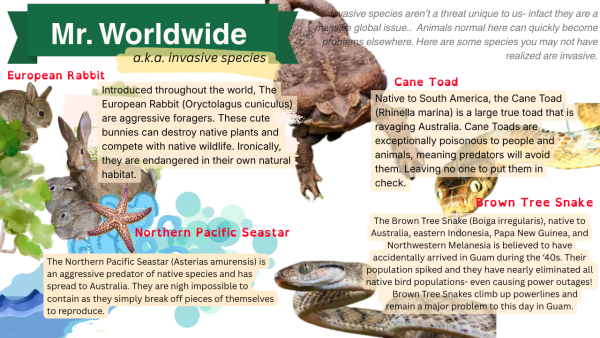
If you’ve ever been to the US Canada border and had to sit in a cold, dreary office while your dad got his boat permit checked, you probably noticed the giant “ABSOLUTELY EVIL: DO NOT ALLOW IN CANADA!!!” poster, emblazoned with almost a dozen invasive fish and aquatic lifeforms that are 100% super evil and will definitely steal your car keys.
Alright, alright, I’ll get back on track.
There are more than 6,500 invasive species across the United States, according to the Department of Agriculture in their Invasive Species Profiles List. This number makes it hard to create a definitive list of ‘all’ the invasive species spanning the U.S. And the vast array and types of invasive species can make it hard to define.
In 2000 the Global Invasive Species Database made a list of 100 most invasive Species across the globe. And even they admit that it is hard to maintain and make a clear-cut list of the worst invasive species.
When you think of an invasive species, though, you probably think of a bug. I may not by an entomologist, but I’ve seen plenty of bugs. And as good, insect-fearing Americans we would like to lay down the (bug) basics.
BUGS!!!!
“ewwwwwww!”
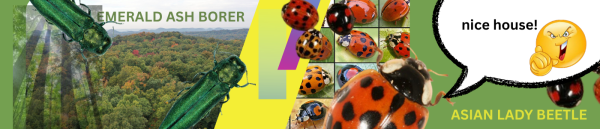
There are an estimated 8 million Ash Trees spanning the United States. Originating from 18 native species, these trees are not only crucial for environments- providing shade for plants, food (leaves and seeds), and shelter for birds to build their nests- but are culturally important to the indigenous people across our nation. Most significant to Northeast tribes are the Black and Brown ash, used for hundreds of years to create snowshoes, baskets, toys and instruments, alongside hunting tools, and medicine.
Over the past 20 years more than 10 million ash trees have died. 10 million. 10,000,000. Killed by a pest that infiltrates and slowly destroys it over the course of multiple years. Before you realize, one dead ash tree becomes ten dead ash trees, and then ten becomes one hundred, and then one hundred becomes a thousand. And now five species of American Ash are considered endangered. And who is the source of this? Why, the Emerald Ash Borer.
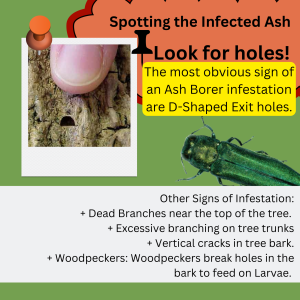
Agrilus planipennis, also know as the Emerald Ash Borer, was first spotted in the United States in 2002 near Detroit, according to the City of Hamilton’s website. Since then, it has spread its terror through Ohio and caused the death of millions of ash trees, made even worse by the fact that it has no native predators. After eggs laid in the bark crevices of ash trees by the EAB hatch, the larvae burrow into the tree and feed, damaging the tree. The Animal and Plant Health Inspection Service states that because of the EAB is sneakily hiding under the bark and the decline of the ash tree being gradual, it is difficult to detect early.
That being said, if you know how to recognize the Ash Borer’s murder campaign, you can also help prevent its spread. National Park Officials take great effort to identify infected trees and promptly dispose of them to hinder the Ash Borer’s spread.
In the past couple weeks you may have noticed little red blobs infiltrating your house. Ladybugs, your mom calls them. This confuses you, because they seem to enter homes for no rhyme or reason, how do they get in when everything is locked up?
These pests, are the Asian Lady Beetles.
Harmonia axyridis, aka multicolored Asian lady beetles, are another menace to society. According to Prevent Pest Control, Asian beetles were initially introduced to the United States in an attempt to protect crops from pests. They were recognized in Ohio in October 1993. And since 1990, they have become the most common lady bug in many habitats, to the point of even outcompeting native lady bugs.
Asian Lady Beetles come in many, many different colors. In fact, they have over 100 documented forms, all with different colors and spot combinations. They can be solid black with red dots, or look more like your ordinary ladybug.
Asian Lady Beetles are the little annoying guys who break into your house during the fall and try to peace out during the winter. This process is known as Overwintering. They can live for over a year, meaning they can eat a whole lotta pests. And this introduces the problem, they can eat, eat, eat leaving nothing behind for the other ladybugs.
Plants
Oh my god, its Honeysuckle, Run!!
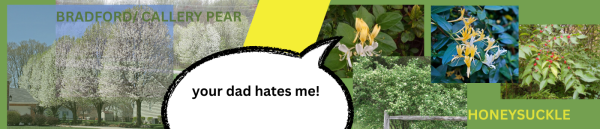
Over the years, many invasive plants have infiltrated Ohio.
According to the Ohio Department of Natural Resources, of the 2,300 vascular plant species in Ohio, only 78% are native, within the 22% of arrivals, there are over 500 non-native species alone.
Although not as infamous as our rapidly approaching second plant, the Bradford Pear or Callery Pear (Pyrus calleryana) are a notable problem- spreading rapidly after their introduction over a hundred years ago. Initially prized for its resistance to fire blight (which is not an actual fire- but a bacterial disease whose rapid spread causes leaves and branches to blacken, as if burnt by fire), the Callery Pear was planted and began to shoot up everywhere.
The Callery Pear is the original version of the Pear. Growing up to 30 to 50 feet tall and sporting a spread about 30 feet wide. They are known for their white flowers that STINK up the spring and produce small fruits that European Starlings just love. And their adaptability to multiple climates meant they were favored for urban planning. It’s bro, the Bradford Pear was cultivated in the ‘50s as a sterile variant, but it cross-pollinated with other species and quickly spread out of control.
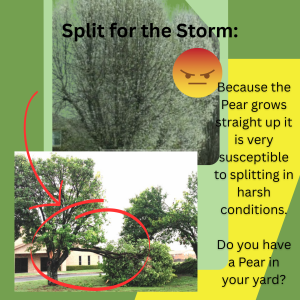
This introduces the issue with the Callery Pear and its varieties- it can hybridize with nearby Pear Trees and quickly become invasive with other Pears. People planting Pear trees are urged to be wary of nearby trees, as they can cross-pollinate easily.
The Callery and its evil cousins are all in all, just a dumpster fire. As their trees will quite literally split under their own weight after 15-20 years of growth due to harsh winter conditions and wear and tear. And today, they are banned from being sold in Ohio, Pennsylvania, and South Carolina and other states are considering it.
The rumbling of impending doom reaches your ears, dank and eerie, announcing the approach of our next contender.
If you know ANYONE, and I mean ANYONE who is even the slightest bit interested in yard work you will never hear the end about Lonicera, better known as Honeysuckle. I mean, Honeysuckle this, honeysuckle that. They are also invasive in Canada and mostly reside in forests, yards, and roadsides. The three most common types of honeysuckle invasive in Ohio are Amur, Morrow’s, and Tatarian. The Invasive Species Centre of Canada states that honeysuckles make it hard for native plants to grow and reproduce by forming dense stands that outcompete these species for access to resources.
As my dad would say, “It gets so thick it kills everything under it!”
Honeysuckle is not fond of “one, two, three, save some for me” and since their introduction, they have been a hallmark of adult’s chainsaw revving antics and the source of many, many hours of work for everyone.
Invasive Species: Our Responsibility
These are merely four invasive species that are present in our community and world, and a reminder that what we might perceive as “ordinary” may not be as normal as we think.
Non-native species, on their own aren’t always invasive. Think corn, remember how it spread over the entire world? We can find plenty of benefit in non-native species whether as livestock, pest-control (here, kitty, kitty!), or erosion control.
But once non-native species spiral out of our control, outcompeting and overtaking native wildlife, we must draw the line.
We will close with the story of the American Chestnut.
You’ve likely heard of Chestnuts, yummy bundles of sweet goodness, but long ago, those little tasty snacks used to span across the United States. In fact, the American Chestnut Foundation estimates that the American Chestnut ruled over 200 million acres from Maine to Mississippi. And within that range over 4 billion Chestnut trees.
Back in their hay-day, the Chestnut ruled supreme. Famed for growing to 100 feet, the Chestnut’s wide-spreading branches created a canopy under which wildlife thrived, and flowered in June-July.
Today, Chestnut wood is a rare commodity, in fact, it is often obtained from old buildings and barns. For our ancestors, Chestnut wood was a strong, sturdy component of their homes. One massive tree produced durable, rot-resistant wood with endless uses. From railroad ties to an infants cradle, the American Chestnut could do it all.
But, in the end, it was not overharvesting or complete human greed that eradicated the Chestnut.
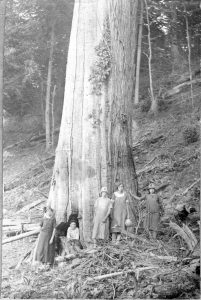
It was the American Chestnut’s crime was a lack of resistance. The Chestnut Blight originating from imported Japanese Chestnut Trees (‘discovered’ in 1904) reduced a population of over 4 billion chestnuts to functional extinction. So shocking was it, that even the largest Chestnut’s began to die out, a mature chestnut could die within 2-3 years. Attempts to contain the blight were futile and of little effect, government efforts ceasing by 1915. By the early 40s, the American Chestnut was a wrap, a story passed down from generation to generation, like the old passenger pigeon and bison, the Chestnut had become a memory.
However, our Chestnuts haven’t entirely given up, or rather, we haven’t thrown in the towel. Conservation groups have sprung up, dedicated to preserving the once great tree. Their methods are vast, but they all have the shared goal of preserving the American Chestnut. And through their efforts to build resistance to the blight, one day, we too might be able to see these great trees return home.
The American Chestnut is a cautionary tale of our responsibility to the environment as a whole. By introducing non-native species we are responsible for everything they bring with them. A lack of forethought has led to many persistent invasive species that we are still dealing with today. But we can work to reverse that damage with the tools at our disposal.
Whether it be reporting a tree infected with the Emerald Ash Borer to national park authorities after finding one on a walk through the park or helping a neighbor rip out honeysuckle, we all can do our part in counteracting invasive species.