








Since its inception, school has had kids reading. Whether it was the olden days with kids reading The Bible or Mary Pope Osborn’s never-ending Magic Tree House series, students have had their noses in books for centuries.
Reading is important, that much is true. In this day and age, we absolutely need to know how to read. It’s necessary for learning, jobs, using the internet, and even deciphering brain rot. And according to BookTrust “reading is essential for acquiring knowledge and creating pathways to greater learning, equitability, creativity, performance, well-being and empathy.”
We spend much of our early childhood learning how to read. I’m sure you remember those days, scrambling to sit on a large (likely navy-blue) carpet with a checkerboard pattern, turning on your listening ears for story time, and listening to your teacher read Green Eggs and Ham for the five-hundredth time.
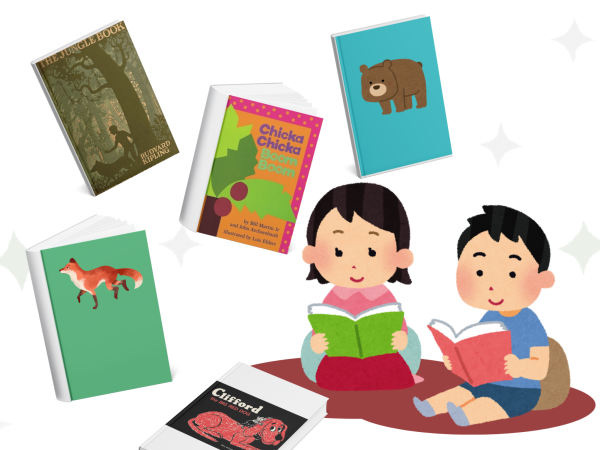
You probably also remember holding a (seemingly) oversized picture book in your little-person hands, staring intently at Curious George and the Man In the Yellow Hat while your parents read to you. You probably don’t remember the actual story or much of the meaning. But that book was doing a whole lot more than help your mom wind you down for bedtime.
Being read to as a child has many cognitive benefits. Aside from important topics and lessons, books introduced you to a bigger vocabulary. The Child Mind Institute summarizes the effects of reading on child development as both cognitive and emotional… “such as helping children develop language skills and literacy, build empathy, and learn how to handle challenging feelings.” In short, When You Give a Mouse a Cookie actually did teach you something other than to NEVER give a mouse a cookie. Thanks Mom!
At school you further develop these skills. In Kindergarten you learn sight words. In First grade you develop your ability to read and write and begin to write about topics important to you. And then in Second you read with fluency and try more challenging books. All of the skills you develop as a child eventually culminate in an ability to confidently read. As stated in Harvard Medical School’s 2016 article, Reading and the Brain, “She has to decode words, she has to have the vocabulary once she decodes the words, she has to know meaning of the words, and she has to read fluently so that she can comprehend a whole paragraph,”.
In these early years our teachers ingrain in us a love for both reading and important lessons we carry into adulthood. We read books that are fun and intriguing, introducing us to new countries, creatures, and civilizations.
There’s a shift, of course, as we move into Junior high and High School, we’re expected to read books with unfamiliar, daunting words and comprehend them. At this point we’ve developed our ability to read mostly well and can mostly keep up. Many of these books have a life-time impact, introducing new ideas and ways of thinking and furthering that love for reading.
We polled students asking for the class books they’ve read, the ones they liked, and the ones they disliked. A limit of three books could be chosen for both liked and disliked books.
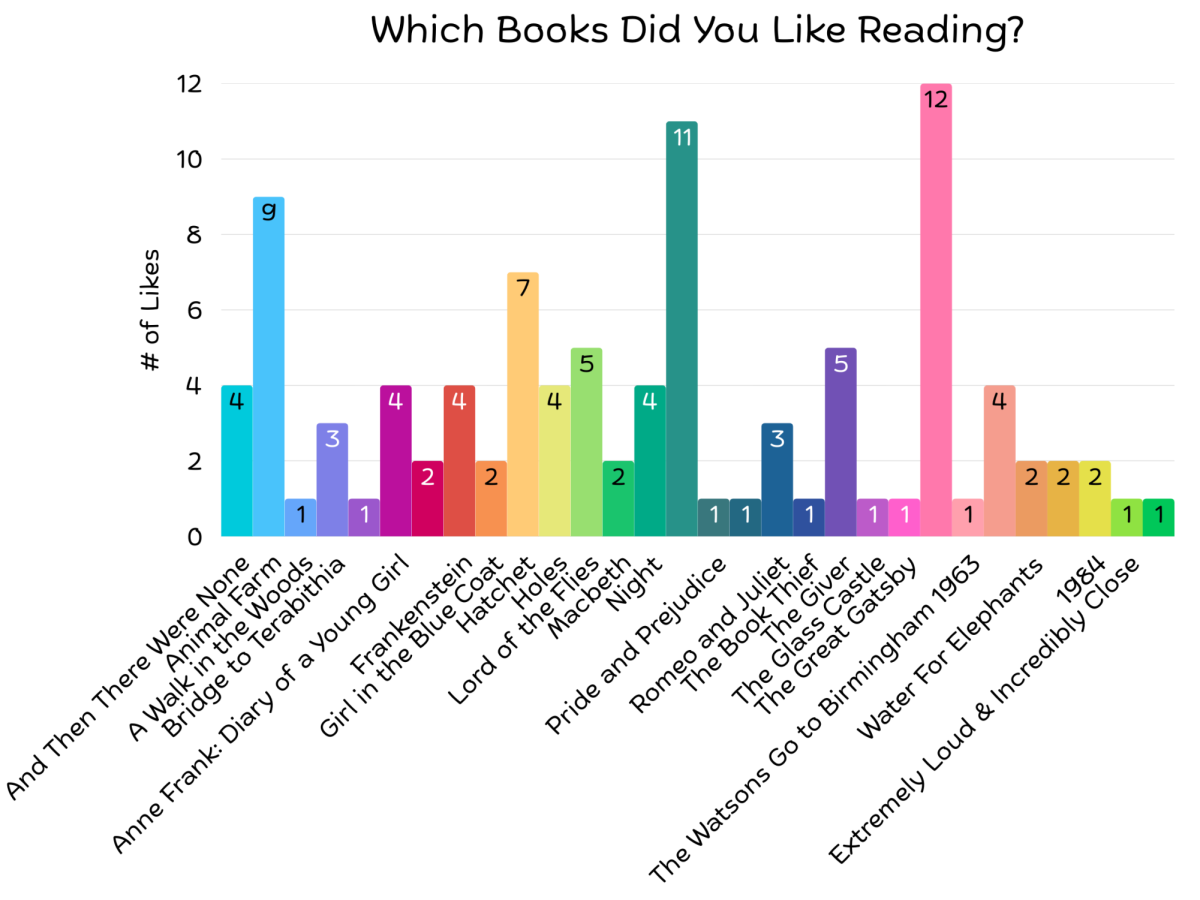
The Outsiders took the lead with the most likes (as of writing), close behind was Of Mice and Men, and then Animal Farm. Monica Hesse’s Girl in the Blue Coat and Gary Paulsen’s Hatchet made up the backline.
On the other hand, the worst offenders are Romeo and Juliet, Of Mice and Men, and Macbeth. Romeo and Juliet and Macbeth were not very surprising, as these have created many a confused, annoyed, and overall frustrated highschooler. Of Mice and Men, however, is the outlier. It ranked high in both likes and dislikes. And most students stated it simply wasn’t their preference or reading style.
Continuing on, respondents were asked whether or not they liked class books/ required readings.
And they didn’t.
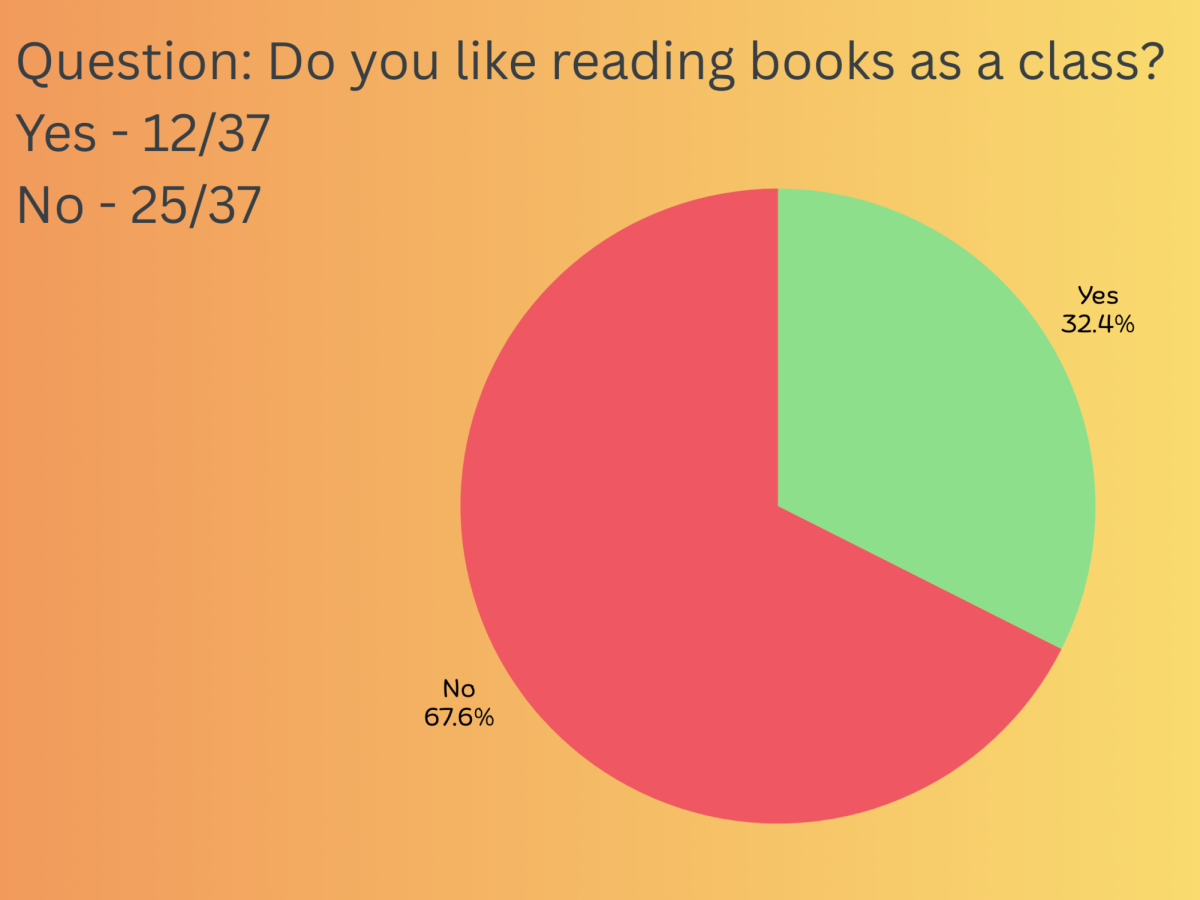
With the majority not liking class books, we then asked the question of if they did/did not like reading. Because reasonably, if you don’t like reading, you probably don’t like assigned readings.
Of our 30+ respondents, the majority said that they liked reading. When asked why, we received a range of responses, most of which were very positive. Here are some of our most common:
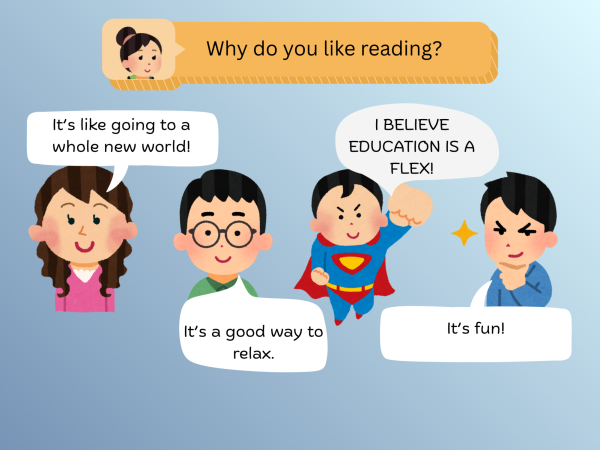
These responses cover far more than the educational benefits of reading. One major reason cited by students is the world created by a book. It draws them in and enamors them with a story. Gwynevere Hill, a Junior, who when asked why she loved to read answered “… because it doesn’t even feel like I’m reading words on a page anymore. I tend to drift off into a book and I can see the scenes in my head like a movie, good books really make for an awesome imagination.”
A Senior, Adianca Ortiz responded “I think I like reading because I like being able to look into another person’s mind” and “Books are basically just a small world created in the author’s mind” and “you learn a lot about the author – who they are, what they think, what they like – but also you can learn a lot about the world around you, past and current events, and problems that repeatedly occur in our world.”
Aside from immersion and an insight into the author’s mind, books grant us access to new ways to view and interact with the world. Words on a page can get across so much more than a movie screen or monotonous reading. “I like reading because writing can describe things that other medias can’t. And, another reason is that I read to read. I struggled at a young age to read, until I got help, but ever since I learned I would always keep reading.”
So if students like reading- why don’t they like reading class books? Most of which are classics and considered trademarks of (American) literature?
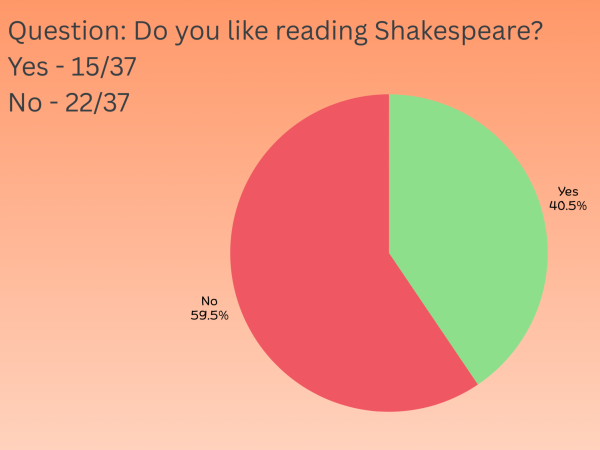
Shakespeare. Romeo and Juliet got a lot of flack from our respondents, but is it
Respondents called it “difficult to enjoy” and “written in difficult terms.” In short, it was confusing to read. Similarly, a common complaint was it being difficult to follow, nonsensical, and just plain old frustrating.
Natalie Douglas, a junior responded “My least favorite book was Romeo and Juliet, I just don’t really like the story and the way the romance is written. It felt fast paced with a lack of depth.” Similarly to a Senior who said “… it was so unpleasant for me to read that I simply didn’t care.”
Junior, Chy Campbell sums up student’s frustrations with Shakespeare’s tragedy “I just hate Romeo and Juliet as characters. They’re, to put it plainly, stupid.”
So Shakespeare is part of the issue, but what other issues do students have with class books? Well, respondents had a lot to say.
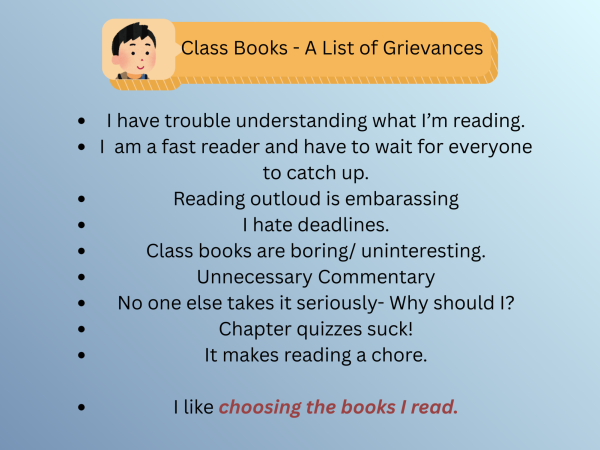
We interviewed Juior Gwynevere Hill, asking what she believed to be the worst part about reading class books, her response was “Pacing. Not everyone reads at the same speed and it frustrates those who read ahead.” She furthers the pacing issue by emphasizing its impact “it lowers the self esteem of those who read slower.”
Gwyn’s response is just one example of many student’s issues with class books.
A Senior remarked on the dread of a looming deadline “I hate the pressure to finish a book by a certain deadline, because it causes me to feel more worried about finishing rather than enjoying the book.”
These are just two of many issues.
On the other hand, the students that liked class books had a solid defense. They liked interacting with their classmates, liked fun activities, and liked it when stories had topics and themes relevant to them.
Harper Carroll, A Freshman emphasized the value of an author’s writing style “Lord of the Flies was my favorite. There would be many reasons as to why I love the book. The few I will say is the way you can’t sense time, how the author shows the message of the book, the symbolism, and the buildup.” These all combined to make it intriguing and flow. Although “One aspect that slightly brought the book down for me is the ending, I still liked the ending but there could have been a little bit more to it.”
So aside from authors craft, what makes a good class book?
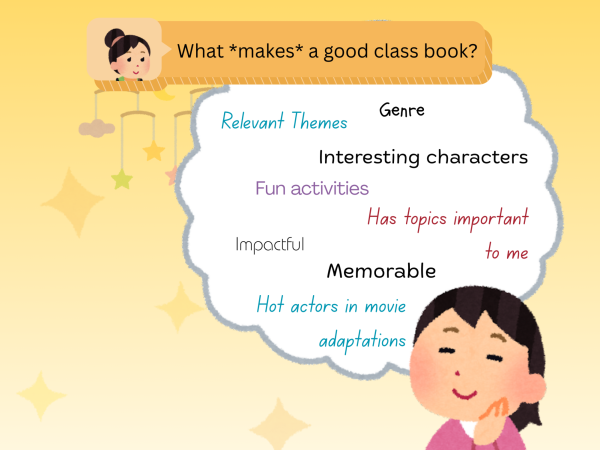
Some of the most important factors are: Teachers, Discussion, and a Good Movie.
Teachers: A good teacher is absolutely instrumental for class books. One who furthers your understanding while encouraging discussion. All in a fun, interactive way that gets everyone involved. A responder remarked “…in 8th grade my teacher helped us understand a lot of literary elements and references that I definitely would have forgot.” When a teacher makes the effort to make it fun and relevant students notice.
Discussion: was also cited as a major factor improving class books. Because class books give us a shared source material, we can draw so much more from it. Responders enjoyed working with their friends and sharing ideas. The idea that Reading books with relatable themes can lead to meaningful conversations about what’s happening in their lives still applies when you reach Highschool is absolutely true.
A Good Movie: Finally, unsurprisingly, a good movie adaptation was also a frequent answer. One responder said that its “… always the best way to finish off reading a book”. Natalie Douglas, a Junior and student at Diamond Oaks, when asked if movies made reading a class book better answered “I do. The movies helps to clear up any confusion in the book.” Natalie added that “With how Shakespeare writes, it gets confusing on what’s actually going on.”
She is referring to the BBC’s 2010 Television Film, Macbeth which takes the story of Macbeth and sets it instead in the mid 20th century, invoking dark, gritty themes. She praised the movies setting “The movie helped set the scene better and made it more understandable by demonstrating the actions of the characters.” By invoking images of dictatorships and Nazi Germany, we are able to see Macbeth’s rapid moral descent. Natalie also remarked upon the movies portrayal of Act 3, Scene 3 and Banquo’s murder. “… The train scene where Fleance runs off was a lot clearer to me in the movie than in the book.” She agreed that by having the scene set on a train, the producers made it more understandable and ‘relevant’ for the audience.
So if student’s don’t like class books- how do we get them to read?
Well, many students said that they liked when teachers gave them the ability to choose the book they read for class from a selection. This allows them to read about what interests them and still learn the intended lessons. One of our responders who praised this said “I think without choice students turn to cheating… which isn’t fair to those who actually read.” In the end, class books are generally hit-or-miss. But they can have a lasting impact on the students that enjoy them. You can’t force a student to like a book, just as you can’t force them to read, but the point remains. Reading is good. For early elementary schoolers, it’s storytime, for high schoolers, it’s Shakespeare. Either way, we’re reading, whether we like it or not- but maybe its time for a little change